










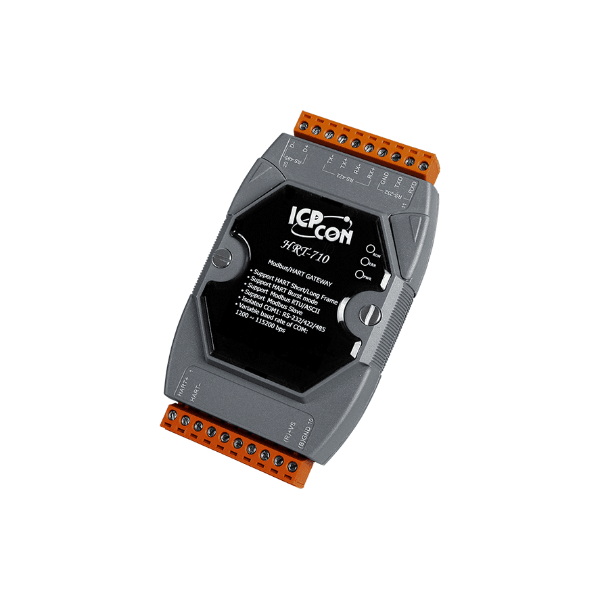
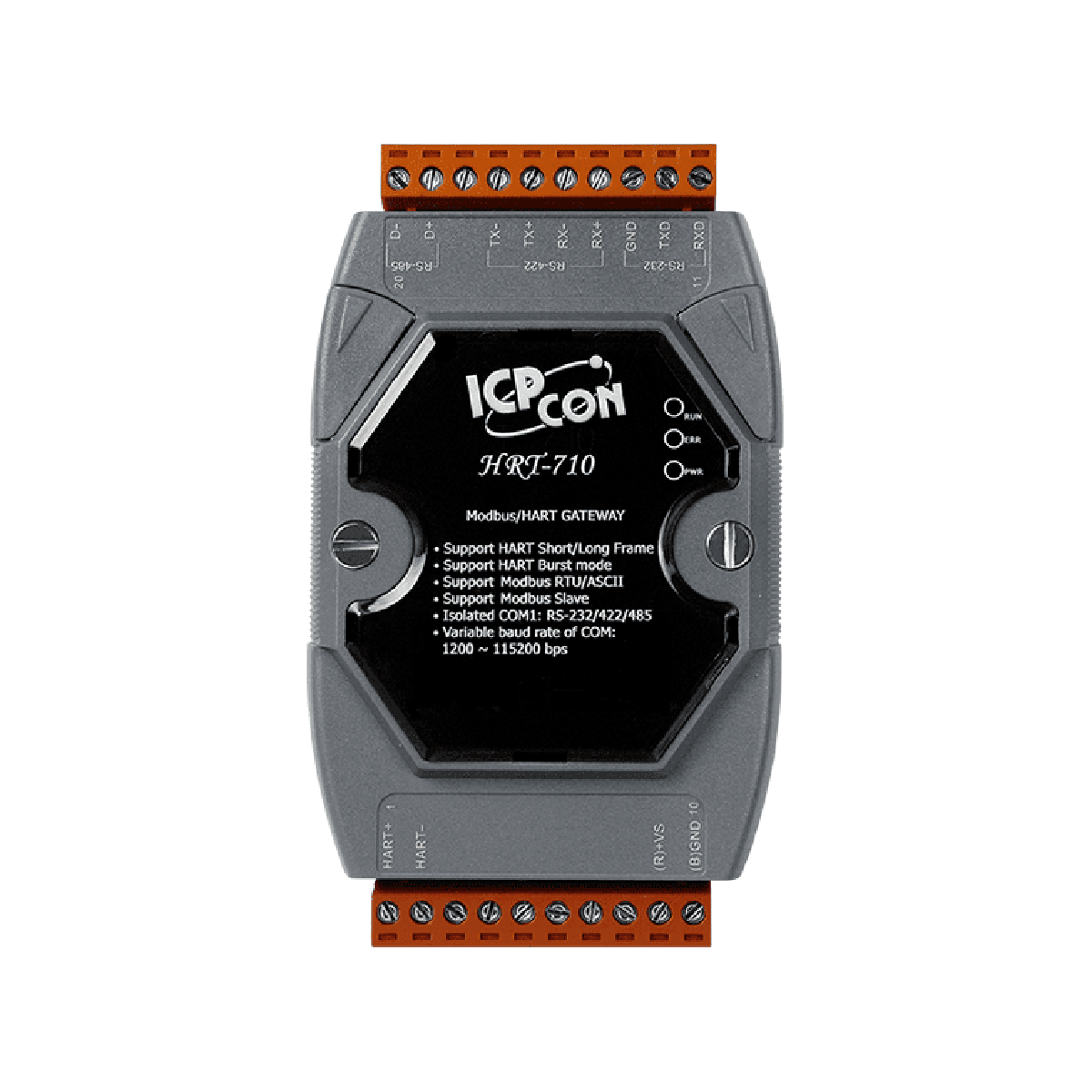
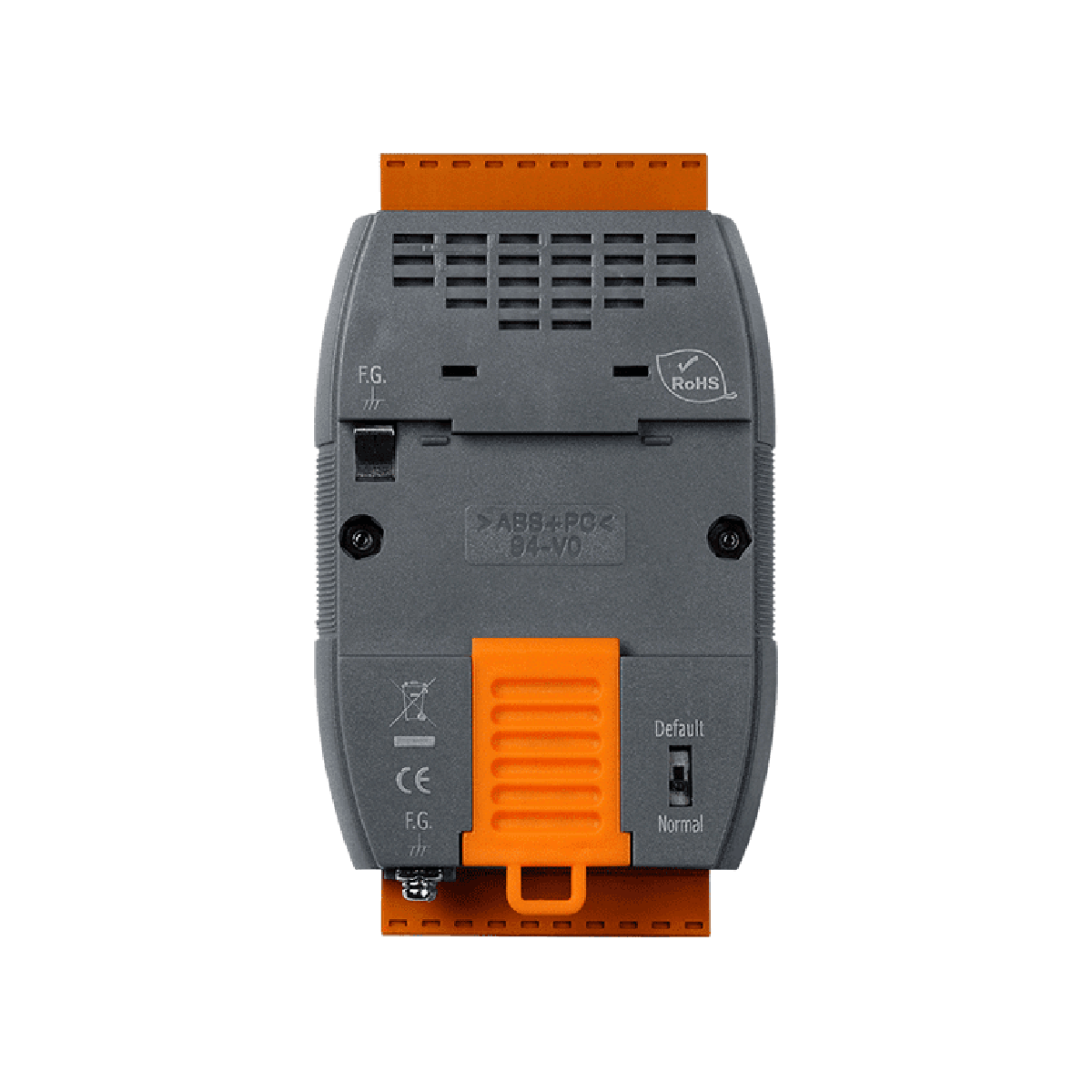
ICP DAS HRT-710 is a compact Modbus RTU/ASCII to HART gateway that allows Modbus master devices to seamlessly access HART slave devices such as transmitters, actuators, and current output devices. Supporting up to 15 HART devices per channel in point-to-point or multi-drop topology, HART burst mode, short/long frame formats, and isolated RS-232/422/485 serial interface with 4 kV ESD protection, the HRT-710 simplifies HART device integration into existing Modbus networks.
ICP DAS HRT-710 is a DIN-rail mounted Modbus-to-HART protocol gateway specifically designed to bridge modern Modbus-based control systems with legacy HART field instruments. Acting as the HART master, the HRT-710 enables any Modbus master device — such as a PLC, PAC, SCADA, or HMI — to read and write data from HART slave devices including flow transmitters, pressure sensors, temperature transmitters, valve positioners, and 4–20 mA current loop devices.
The HRT-710 supports a single HART channel that can connect up to 15 HART slave devices in multi-drop topology, or a single device in point-to-point mode. Both 2-wired and 4-wired HART device configurations are supported, providing compatibility with the full range of HART field instruments regardless of their power and signal wiring scheme. HART burst mode is also supported, allowing HART slave devices to continuously broadcast data without waiting for a poll request — improving data update rates for time-sensitive monitoring applications.
Two HART masters can share the same HART network simultaneously, enabling, for example, a handheld HART communicator and the HRT-710 to coexist on the same loop — a critical feature for on-site commissioning and maintenance without interrupting normal operation. A built-in 250 Ω loop resistor is selectable via jumper, eliminating the need for an external resistor in standard 4–20 mA HART current loop installations.
The serial interface (COM1) supports RS-232 (3-wire), RS-422, and RS-485 — selectable to match the host system's serial port type — with baud rates from 1,200 to 115,200 bps. The COM port is electrically isolated (following UL1577 specification), protecting both the HRT-710 and connected equipment from ground loop interference and electrical transients. ESD protection of 4 kV class A safeguards the unit against electrostatic discharge.
Free utility software provided by ICP DAS enables users to configure the HRT-710, read/write HART device parameters via HART commands, view Modbus address mapping of HART commands, and access diagnostic information — all without requiring custom programming. The ultra-low power consumption of 1 W makes the HRT-710 suitable for energy-constrained installations. The HRT-710-UTA variant extends the operating temperature range to -40°C for extreme cold environment applications.
_application.jpg)
The HRT-710, a gateway that converts HART master communication to Modbus slave communication, is designed to integrate data from HART flow meters into a customer’s HMI system. By using the HRT-710, the connected HART flow meters can be recognized as Modbus slave devices, allowing the HMI system to easily access and monitor them through its built-in Modbus RTU communication interface.
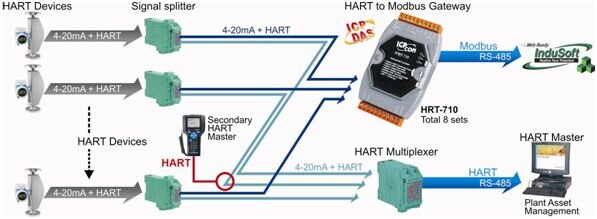
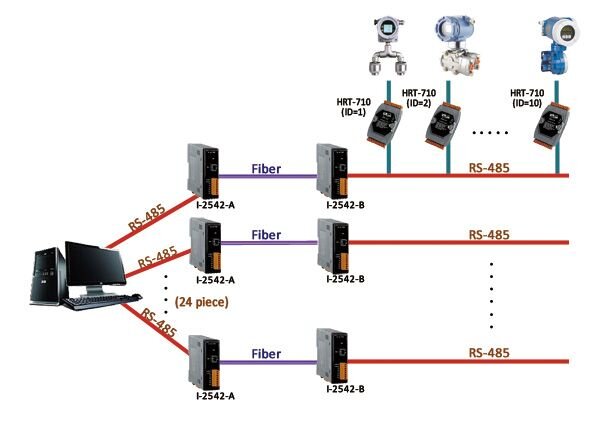
More than 250 HART devices need to be connected and monitored within the surveillance center. On the PC side, three PCI expansion cards, VXC-148U, are utilized to provide 24 RS-485 communication channels. I-2542A and I-2542B modules are installed on each RS-485 channel to extend the communication range. Around 20 units of HRT-710 are connected on every RS-485 channel, each configured with a unique station ID. With this architecture, the SCADA or HMI system can efficiently collect and access all HART device data through the Modbus protocol.