











.png)
ICP DAS MDC-700 Series is a Modbus data concentrator that integrates multiple RS-232 and RS-485 Modbus slave devices into a single Ethernet interface. With a shared data pool of up to 9,600 registers per data type, 250 polling command definitions, parallel COM port communication, and support for up to 8 simultaneous Modbus TCP connections, the MDC-700 Series simplifies centralized data monitoring for SCADA and industrial automation systems via simple CSV file configuration and an HTML5 web-based UI.

ICP DAS MDC-700 Series is a Modbus data concentrator designed to bridge multiple legacy RS-232/RS-485 Modbus RTU slave devices into a modern Ethernet-based Modbus TCP network. By consolidating data from multiple serial devices into a continuous Modbus register address space, the MDC-700 allows a host SCADA system or PLC to read all field device data in a single bulk Modbus TCP request — dramatically reducing network overhead and simplifying host-side polling logic.
The MDC-700 Series supports up to 250 user-defined Modbus polling command definitions across all COM ports, with a shared data pool of up to 9,600 registers for each of AI, AO, DI, and DO data types. Each COM port operates in parallel — meaning polling on COM1 and COM2 happens simultaneously rather than sequentially — significantly accelerating total data refresh rates across large device networks. Write commands (write holding registers, write coils) are assigned first priority in the command queue, ensuring that control outputs reach field devices without delay even during heavy read polling cycles.
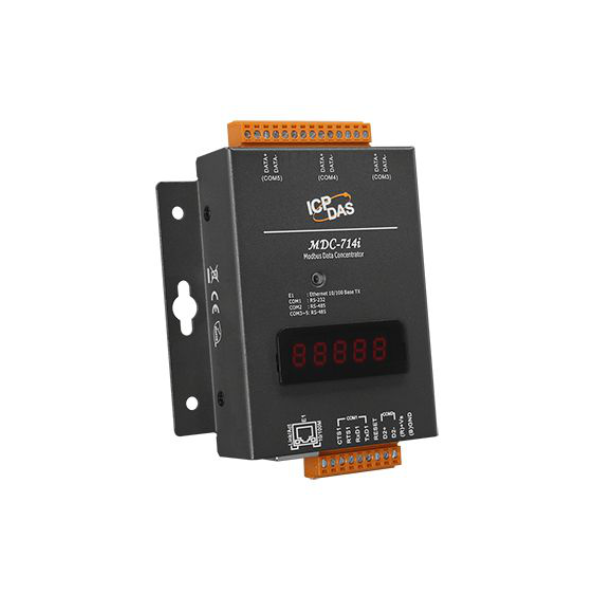
Available in five models to match different I/O port requirements, the MDC-700 Series covers a wide range of deployment scenarios. The MDC-711 provides 1×RS-232 and 1×RS-485 for small systems; MDC-714 expands to 1×RS-232 and 4×RS-485 for larger RS-485 networks; MDC-714i adds 3 isolated RS-485 ports for electrically noisy environments; MDC-741 offers 4×RS-232 and 1×RS-485; and MDC-771 provides 7×RS-232 and 1×RS-485 for systems heavily relying on RS-232 devices.
Configuration is performed through a simple CSV file — defining polling commands, register mappings, and COM port parameters in a familiar spreadsheet format without specialized software. An HTML5 web-based user interface provides browser-accessible configuration import/export and system monitoring from any device on the network without additional software installation. A 5-digit 7-segment LED display on the front panel shows the unit's IP address for quick field identification, while a heartbeat LED indicator confirms system operation status.
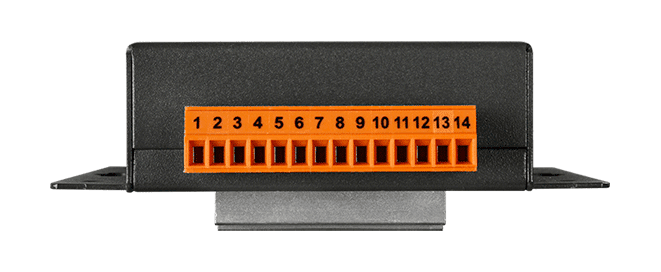
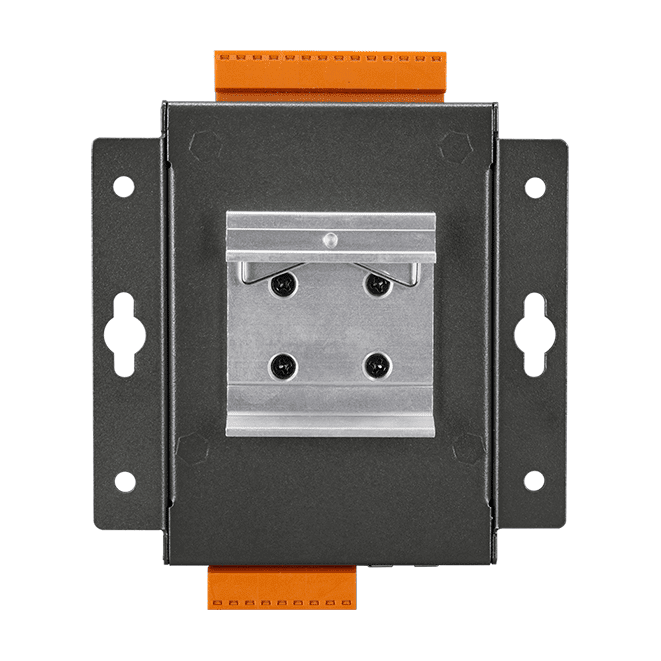
All models feature a metal housing with wall-mount installation, wide power input of +10 to +30 VDC, ultra-low 2.5 W power consumption, and an operating temperature range of -25°C to +75°C for reliable industrial deployment.